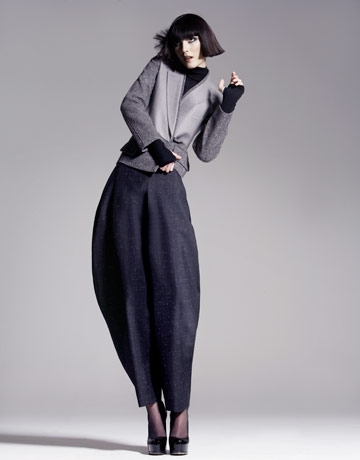
 Featured: Stefano Pilati for YVES SAINT LAURENT
Explore volume and proportion by challenging conventional principles of tailoring for your Autumn wardrobe. Here is a great example by Stefano Pilati for YVES SAINT LAURENT, a ‘zoot’ trouser balancing a fitted cropped top. The pattern draft is a bit more advanced for those daring to try pleated trousers yet it is an easy project to construct.
You will need:
- Bottom-weight fashion fabric, 54” [137cm] wide **
- ¼ yd. [0.25 m] of fusible interfacing, 45” [114cm] wide.
- ⅓ yd. [0.30 m] of pocketing fabric, 45” [114 cm] wide
- 1 zipper, 7” [18 cm] long.
- 1 set of pant hook & bar
- Kraft paper
** A minimum of 3 yards of fabric is required for pleated trousers – for an average sized person. If you’re taller than 6′ – you’ll need 3 1/2 yards of fabric.
MEASUREMENTS
Waist – measure around narrowest part of torso just above the navel.
Hip – measure around fullest part of seat, about 9” [23cm] below waistline.
Body Rise – measure vertically from waistline to top of chair seat, while seated.
Outseam – measure vertically from waist to heels.
Trouser Bottom Width – measure length of foot.
PATTERN
Easy Fit template for “baggy” trousers.
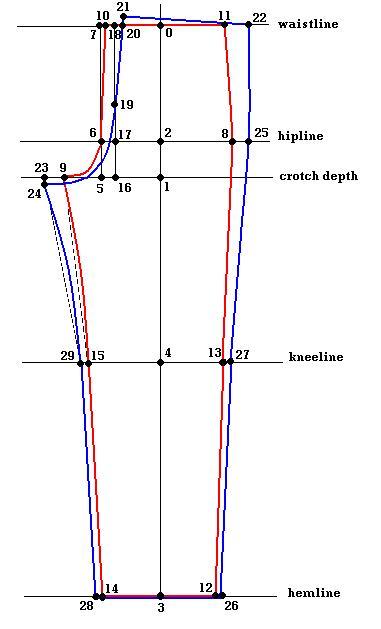
Front (Red)
Draw a long straight line down center of the paper and plot point 0 at the top end.
Square both ways from 0.
0-1 = body rise – waistband width + ⅜” [10mm]; square across.
0-2 = 9” [23cm] – waistband width; square across.
0-3 = outseam – waistband width; square across. (creaseline)
1-4 = half the measurement of 1-3 minus 2” [50mm]; square across.
1-5 = 1/12 of hip + ¾” [20mm]; square up to locate 6 and 7 at intersections.
6-8 = ¼ of hip + 1” [25mm].
5-9 = 1/16 of hip + ⅜” [10mm].
7-10 = ⅜” [10mm].
Join 10-6 with a straight line and 6-9 with a smooth curve, missing 5 by approx. 1 ⅜” [35mm].
10-11 = ¼ of waist + 2” [50mm].
3-12 = ½ of trouser bottom width – ¼” [6mm]; join 8-12 with a straight line. Mark point 13 on kneeline.
Draw in side seam; join 8-11 with a slight curve.
3-14 = ½ of trouser bottom width – ¼” [6mm].
4-15 = the distance of 4-13.
Draw inside leg seam; join 14-15 with a straight line; join 9-15 with a slight curve inwards ⅜” [10mm] as shown.
Back (Blue)
5-16 = ¼ of measurement 1-5; square up to locate 17 on hipline and 18 on the waistline.
16-19 = half the distance 16-18.
18-20 = ¾” [20mm].
20-21 = ¾” [20mm].
21-22 = ¼ of waist + 2 ⅜” [60mm]; join 21-22 to touch the horizontal line from 0.
9-23 = half the distance 5-9.
23-24 = ⅛” [3mm].
Join 21-19 with a straight line; join 19-24 with a deep curve missing 16 by approx. 1 ¾” [45mm].
17-25 = ¼ of hip + ¾” [20mm].
12-26 = ⅜” [10mm].
13-27 = ⅜” [10mm].
Draw in side seam; 22-25 curves outward slightly; 25-27 curve inwards slightly and join 27-26 with a straight line.
14-28 = ⅜” [10mm].
15-29 = ⅜” [10mm].
Draw inside leg seam; join 28-29 with a straight line; join 29-24 with a curve inwards by ⅜” [10mm].
Design Note: PUT EXTRA EASE IN THE SEAT ANGLE (CB seam)
Most easy fitting trousers require extra ease in the back crotch line, especially pleated pants. Trace off back section of trouser template and add more ease. Begin by, cutting along the hipline and spread open a wedge as desired, approximately 1 ½” [40mm] wide at the back CB line. (The more rounded the behind, the greater the seat angle.) Re-draw the back seam curve as shown.
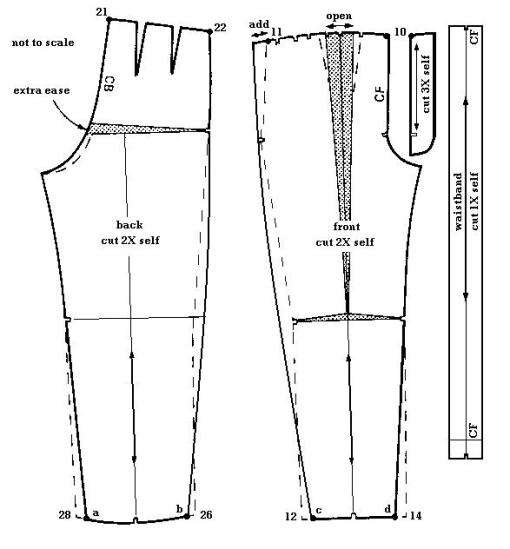
Style Adaptation
Pleated “zoot” trousers are full at the waistline and shaped in at the hem.
Trace round basic easy-fit trouser template onto additional paper.
Back Section *
Add additional ease in CB seam if necessary (see above).
Mark points (a) and (b) on hemline ¾” [20 mm] inward from leg seam.
Draw straight line from (a) to kneeline.
Draw in a bowed outseam (curve) from hipline tapering to (b).
Shape the bottom hemline with a slight curve outward ⅜” [10mm]. ***
Divide line 21-22 into 3 equal parts. At each point, draw in a waist suppression dart. (2 in total).
Dart = 1 ⅛” wide x 4” long [30mm x 100mm].
Front Section *
Trace round front trouser template onto additional paper.
Cut across kneeline; then cut top section dividing along the crease (grainline). Spread open at waistline for desired amount of pleating and extend waistline at side seam to blend smoothly with outseam of leg. (For instance, open 2” [50mm] at waist and extend 1 ⅜” [35mm] at side seam. With dart allowance this gives 4 ⅛” [10.5 cm] fullness).
Divide fullness into 3 equal pleats.
Design Note: More fullness can be added at the waistline by opening the grainline further at the waist and making deeper pleats.
Mark points (c) and (d) on hemline ¾” [20 mm] inward from leg seam.
Draw straight line from (d) to kneeline.
Draw in a bowed outseam (curve) from hipline tapering to (c).
Shape the bottom hemline with a straight line. ***
Grainline is parallel to creaseline.
For fly & fly facing *, trace off CF seam and waistline from 10.
Draw a parallel line 2” [50mm] from CF line and taper 1” [25cm] below zipper notch.
Grainline is parallel to CF line.
For waistband *, draw a long rectangle equal to the waist measurement X desired width.
Add a 2” [50mm] extension to one short end of pattern.
 Mirror the final dimensions of the waistband along the foldline.
Grainline is parallel to foldline.
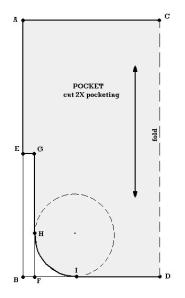
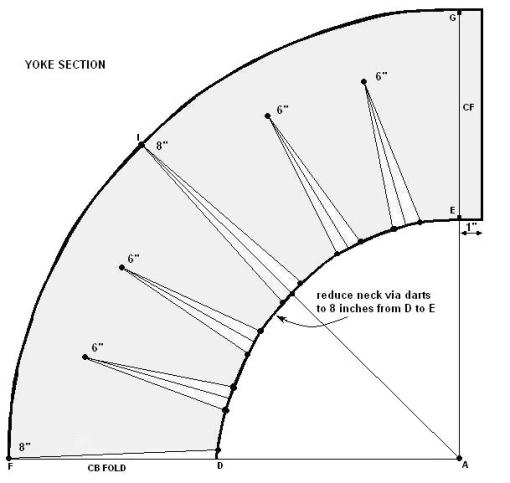
For sideseam pockets, make a pocket bag pattern *.
A-B = 9” [23 cm]; square across from A and B.
A-C = 6” [15 cm]; square down to locate D.
A-E = 6” [15 cm]; square across.
B-F = 1” [2.5 cm]; square up to G.
Draw in an arc with a compass from H to I as shown.
Fold paper on line C-D and trace off C-A-E-G-H-I-D as mirrored image. Open flat for bag pattern piece.
Grainline is parallel to foldline.
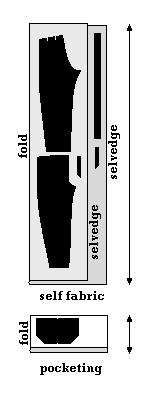 * Add seam allowances to all pattern pieces.
*** Add 1 ¼” [30mm] hem allowances to trouser bottoms.
CUTTING
Front Leg – cut 2X self
Back Leg – cut 2X self
Waistband – cut 1X self
Waistband Interfacing – cut 1X fusible
Fly – cut 3X self
Pocket Bag – cut 2X pocketing
ASSEMBLY
1. Fold pocket bag piece in half crossways and stitch a French seam along curved edge of bag. Set aside.
2. Iron fusible interfacing to back (wrong side) of waistband, following manufacturer’s directions. Set aside.
3. Fold pleats along waistline of front trousers and baste down. Set aside.
4. Sew waist darts on back trouser. Set aside.
5. Finish seams on all cut pieces with pinking shears or overlock machine.
6. With right sides together (RST), align and match side seam of front and back trouser legs. Leaving a 6” opening from top edge of cut pieces for pockets, sew up the side seam and press open.
Attach a pocket bag to each seam allowance at the opening and stitch in place. Set aside.
7. 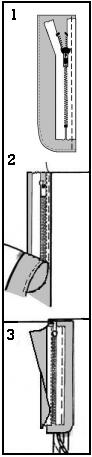 With RST, sew curved edge of fly facing. Grade seam allowance and turn RIGHT SIDE OUT. Press seam and topstitch. With the fly facing FACE UP and the curved edge to your left, stitch the zipper FACE UP to the straight edge of the fly facing (fig.1). Set aside.
8. With RST, sew fly to right front leg. Grade seam allowance and press seam to one side. Under-stitch fly.
9. With RST, align and match front pieces along CF line and crotch. Stitch from bottom of fly to within 2” of the inseam.
10. With the fronts FACE UP, sew the fly facing FACE DOWN to the left front leg. This will encase the zipper into the CF seam. Flip the zipper FACE UP and edge-stitch along the zipper teeth (fig. 2).
11. Lay the front of the trousers FACE UP. Align the CF line and smooth out the fly opening. Baste the fly opening shut. Once completed, fold the fronts in half with the left front leg on top. Pin back the fly facing to reveal the zipper FACE DOWN on the fly. Stitch the zipper tape to the fly. (fig. 3) Baste curved edge of fly to left front.
12. With garment FACE UP, sew a J-stitch to secure the fly. Begin with a bar-tack at the bottom of the fly opening and topstitch the J-stitch following the basting thread markings up to the top.
13. With RST, align and match back and front at the inseam. Baste/pin raw edges together along the inseam of each leg. Sew inseams and press seam open.
14.  Pull one leg RIGHT SIDE OUT and drop down into other leg. Align and match up inner leg seam and CB crotch seam. Baste/pin crotch seam. Sew seam from bottom of fly to top edge of back section (in a U-shape). Turn garment RIGHT SIDE OUT and set aside.
15. Turn under seam allowance on one long edge of waistband and press flat. Fold waistband in half, with RST and stitch up short ends, allowing for seam allowance. Trim corners and grade. Turn waistband RIGHT SIDE OUT.
16. Pin raw edge of waistband FACE UP to inside edge of trousers waistline, allowing for 2” [50mm] extension on left-hand side of waistband. Ease in waistline onto waistband. Baste across top of pocket bag and pleats. Stitch waistband to waistline, ensuring to catch top of front pocket and pleats in the seaming. Grade seam allowance and turn up into waistband. Align and match folded edge of waistband to machine-stitching on FACE SIDE of garment. Edge-stitch the waistband to the garment.
17. On each cuff bottom, turn up 1 ¼” [30mm] hem. Turn under ¼” [6mm] and hand-stitch hem in place.
18. Hand-stitch set of hooks and bars onto the waistband, just above the zipper.
Design Tip: Design the waistband width ½” [12 mm] greater than the width of your favourite belt and add belt loops.


 Featured: Oscar de la Renta Tiered Gown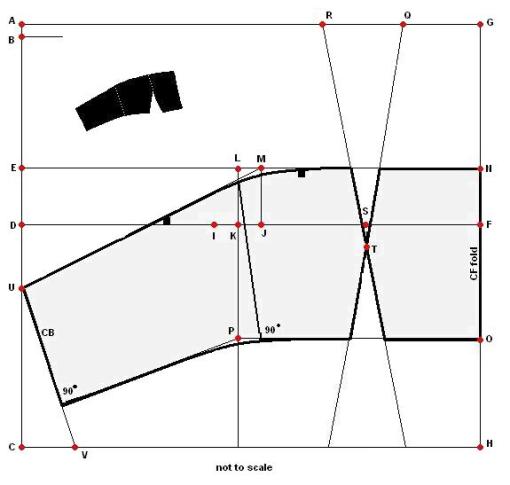
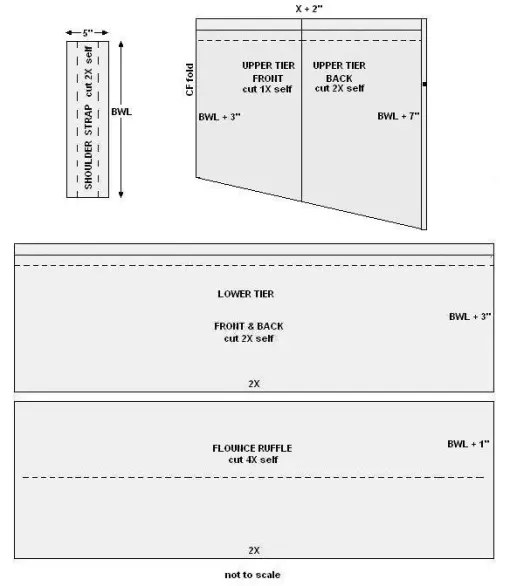
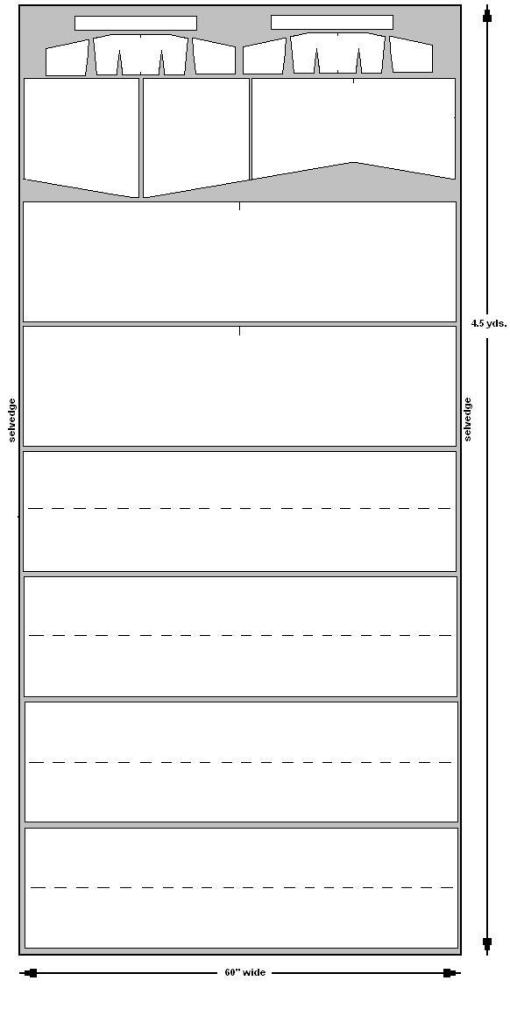
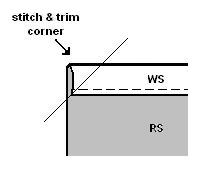
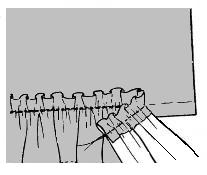
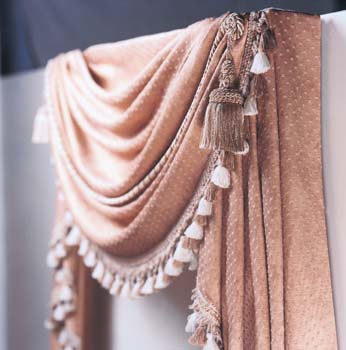 Photo Credit: Arlene’s Interiors
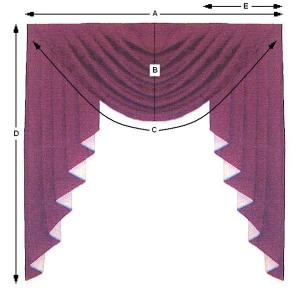 MEASUREMENTS
 Mark the center of the top and bottom edges of the swag pattern (A-B).
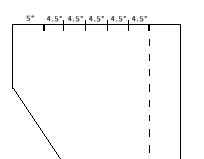 markings on opposite side and open pattern flat.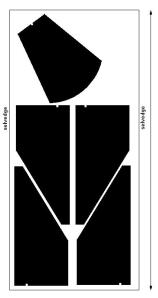
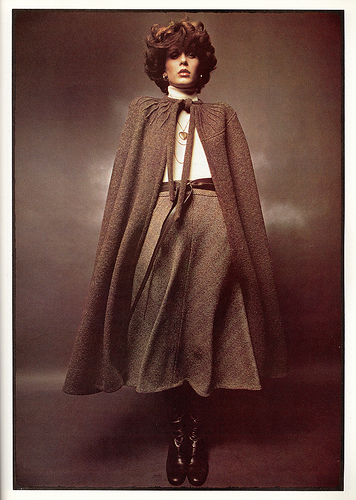 Featured: Luba tweed cloak
 CUTTING
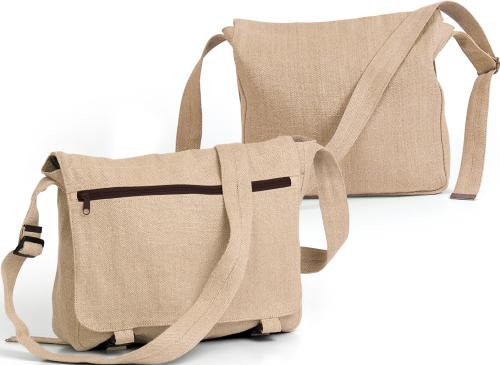 Featured: Messenger Bag by Ecolution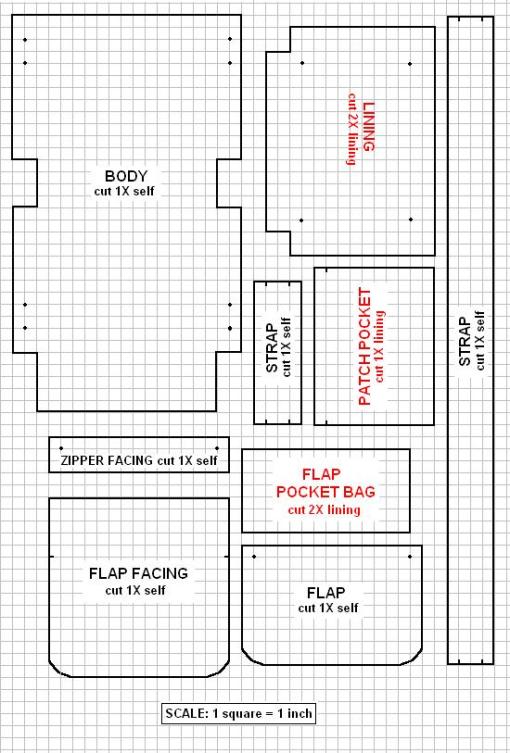
 Bag Body – cut 1X self; cut 1X fusible
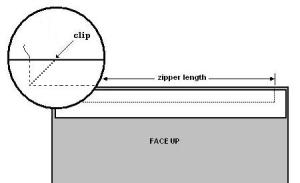 4. Prepare flap pocket. Begin by aligning the zipper facing with the top of the flap, right sides together. Stitch an outline of the pocket opening equal to the length of the zipper teeth X half the zipper’s width.
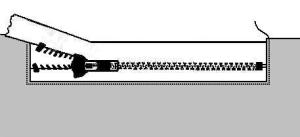 With the flap piece FACE UP, align and center the zipper FACE UP in the indentation.
 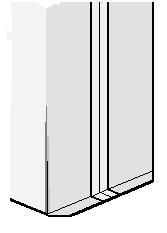 5. Construct the body of the bag. With RST, fold the bag body together and match up the side seams. Sew side seam and press open.
 opening. Stitch around the opening and the flap.
 Featured: Ella Moss Camisole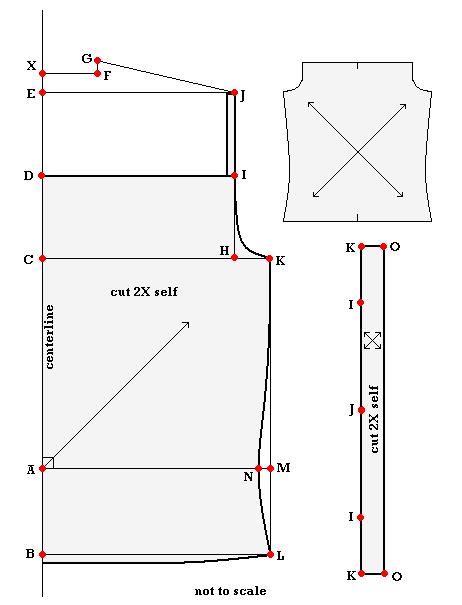
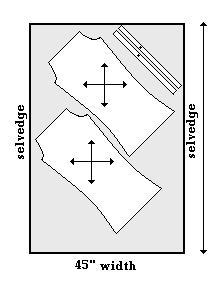 CUTTING
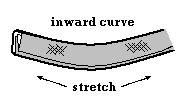 With right sides together, align and match front to back at side seams. Stitch 1” [25mm] from top edge on stitching line. Stay-stitch the armholes.
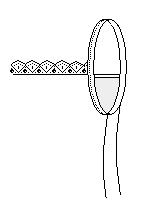 Pre-shape the bias binding to match armhole edge of garment by stretching the two folded edges to match the shape of the inward curve of the armhole.
 Weekend designer